
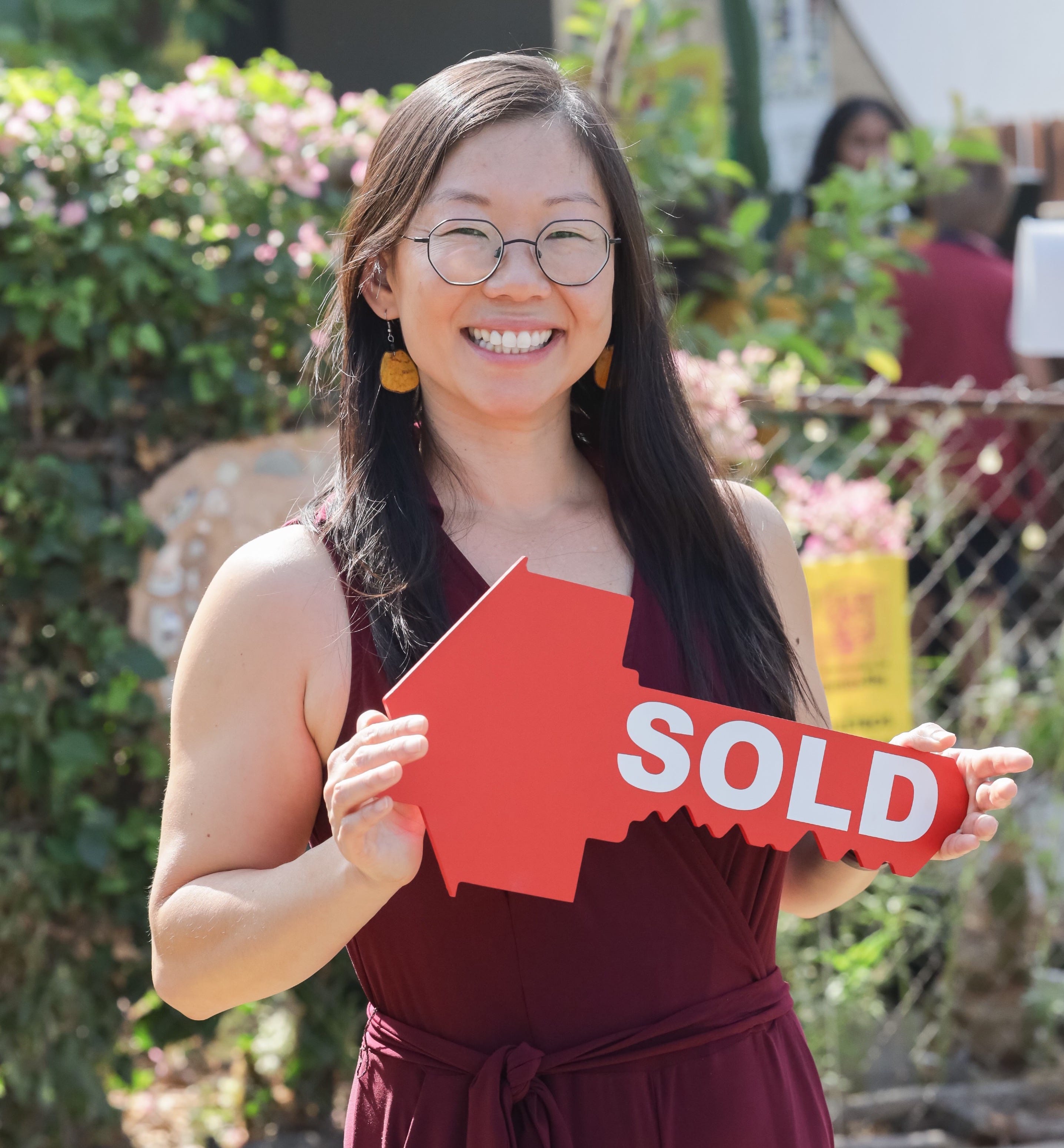
In my last post, I explored the many ways community ownership is taking shape across the country. I came into this work thinking primarily about wealth building: communities owning assets that generate economic value over time. My conversation with Helen Leung, Executive Director of LA-Más, broadened that understanding.
In Northeast Los Angeles, LA-Más buys apartment buildings to preserve affordable housing and help longtime residents stay. LA-Más and its partners own the buildings, while residents help guide decisions about their homes. The value is immediate: affordable rent, greater stability, and a meaningful say in the place they call home—conditions that make saving for the future and building a life possible.
This is the first conversation in Built by Community, a recurring interview series with leaders across the country who are putting community ownership into practice—what they’re building, how they finance it, and what they’re learning.
I’m glad to begin in my home state of California, with Helen, who is working to help people and families stay and thrive in the very community that raised her.
For readers who are new to LA-Más, what do you do? How did community ownership and affordable housing become part of your work?
LA-Más started more than a decade ago as an urban design nonprofit. We worked with working-class homeowners to build accessory dwelling units, helped small-business owners improve their storefronts, and worked on other design and community development projects.
COVID really changed our work and cemented our new mission as a community-based nonprofit centering working-class residents. During the pandemic, our office became an organizing base for mutual aid across Northeast Los Angeles.
We realized we had become a different kind of organization—much more place-based and rooted in the community. We spent a year engaging residents about what our priorities should be, and housing emerged as one of the biggest.
As displacement pressures grew, we realized advocacy alone wasn’t enough. We needed to own and steward real estate ourselves—taking existing affordable housing off the speculative market and preserving it for the long term.
We made our first acquisition just two years ago. Today, we steward five residential projects with 54 permanently affordable homes, helping more than 140 neighbors remain rooted in Northeast LA.
You grew up in Northeast LA. How has your experience of the neighborhood—and the ways it’s changed—shaped your work?
I was born in Los Angeles and raised in Frogtown, so this work is deeply personal to me. I come from a working-class immigrant family–really, the working poor. These are the communities that shaped me.
I grew up playing in the LA River with my sister and biking with friends from elementary school. Almost all my classmates were children of immigrants from Latin America and Asia with parents who were just trying to make it, who didn’t speak English and didn’t understand the systems. I always wanted more for Frogtown and for Northeast LA neighborhoods.
When the neighborhood was still very industrial, it was our playground. I remember going to the frame factory two doors down to pick up cardboard to build a cardboard house. Those commercial spaces have changed so much. Now they’re hip businesses and adaptively reused. So many of my friends I grew up with could not afford to stay, especially if they were renters. I feel so lucky, and I know so many of my neighbors were not so lucky. That is something that keeps me doing the work.
It was community and local organizations that gave me the support to become, frankly, a statistical anomaly in terms of economic mobility from one generation to the next. I have a dear love for the people and the places that raised me in Northeast LA.
Before LA-Más, I worked in local politics, land use and planning, and I joined LA-Más in 2013, not long after it was founded. I’ve been part of the organization as both LA Más and Northeast LA have changed dramatically. It is a privilege to do this work at LA Más, close to the river and people that raised me.
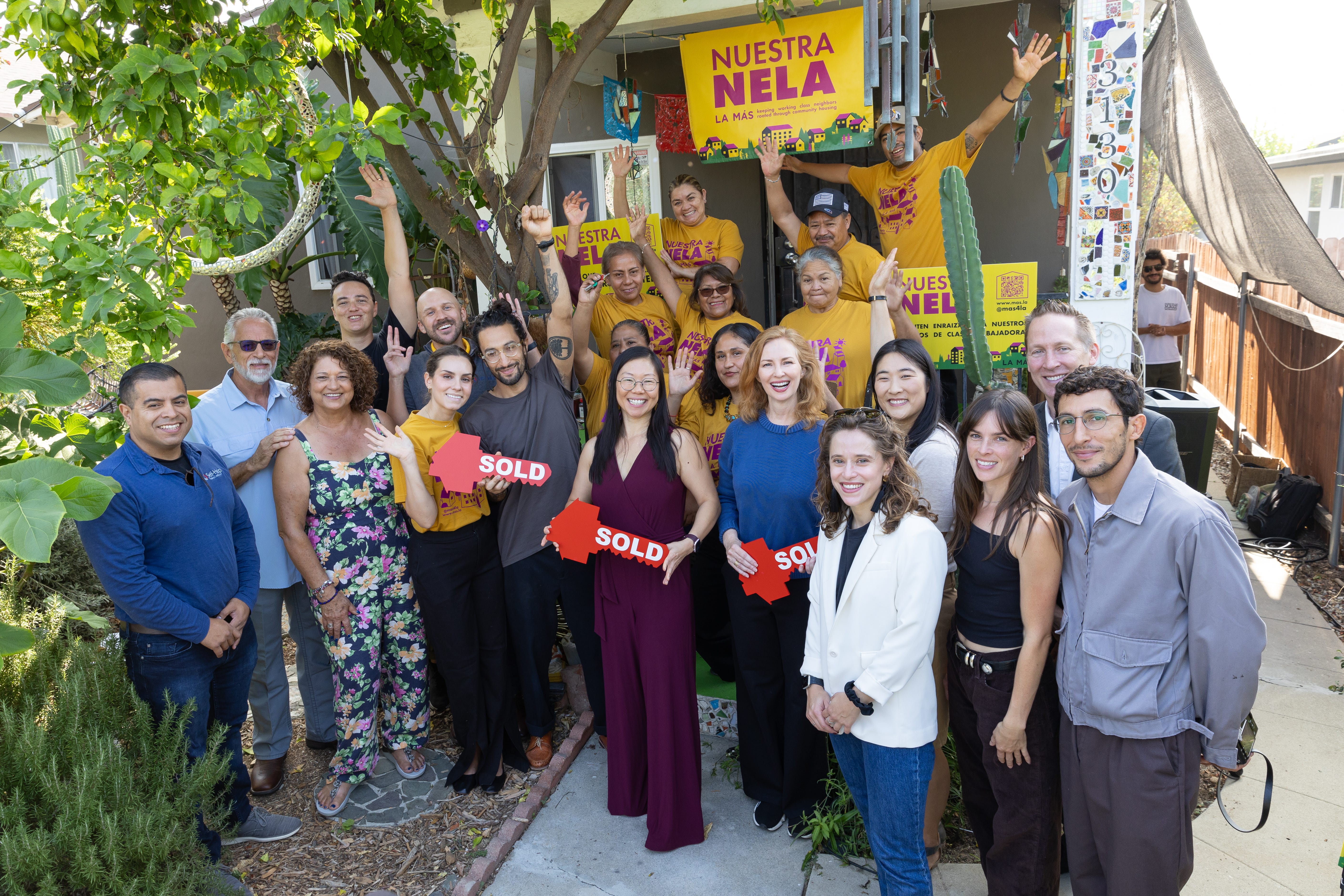
Tell us more about your model of community ownership. What are your goals and how does it work?
Our goal is to acquire buildings that are still home to working-class residents before they’re lost to speculation.
We generally focus on households earning 50% of area median income or below, and we preserve existing rents rather than buying buildings that have already been flipped. We partner with Self-Help Ventures Fund on acquisitions, with LA-Más serving as the managing partner. Our goal over time is to build our capacity and ownership while keeping these homes permanently affordable.
As owners, LA-Más is committed to investing in these homes so they feel like places of dignity. That begins with essential care behind the scenes, like a new roof, updated electrical, and plumbing repairs. It also lives in what can be seen and felt, like fresh paint, a shared space for gathering and programming, and plants allowed outside their doors.
Resident governance is central to the model. We have a Community Governance Committee made up of working-class Northeast LA residents that helps evaluate potential acquisitions and make strategic decisions about the portfolio. Then, once we acquire a building, residents decide how they want to govern it and have a say over major decisions affecting their homes.
My hope is that residents feel true ownership of their homes, that they help guide decisions that touch their lives, and that this circle of care and choice keeps growing as we find more resources and more room to give.
Can you share an example of how community ownership lets you respond differently to what residents need?
One example of what that looks like happened at our Chapman Street building. A senior resident wanted to move into a renovated first-floor apartment but needed her rent reduced by $300 so she could work less cleaning houses. At the same time, a great-grandmother upstairs needed a wheelchair-accessible unit. We were able to move the first resident into the renovated apartment at the lower rent, convert her old unit into an accessible home for the great-grandmother, and rent the vacated upstairs unit at market rate to help make the economics work.
That’s the kind of flexibility community stewardship can create. Instead of maximizing the rent on every apartment, we ask: what do the people who live here actually need, and how can the building work financially while meeting those needs?
I want to talk more about your portfolio. LA-Más made its first community housing acquisition only two years ago. Your growth since then is astounding! How did you get from your first purchase to where you are today?
Two years ago, we weren’t even in the housing market. Today, we’ve raised about $13 million and steward five projects with 54 permanently affordable homes.
We’ve learned how to do this by doing it. Our first acquisition was a five-unit building on Arvia Street in Cypress Park. The family selling it was hearing from investors and developers who planned to displace the existing tenants and reposition the property. They gave us a chance to put together another option.
That first deal helped establish our partnership with Self-Help. Then tenants started finding us. Residents of a five-unit building on Hancock Street reached out after reading about Arvia.
Later, a member of our Community Governance Committee brought us a 12-unit building on Chapman Street, where 40 residents had spent more than a year withstanding cash-for-keys offers.
Each acquisition has built our track record, our relationships, and our ability to take on the next one. Now Drew Street adds 31 more. And we’re doing all of this as a very small organization. We’ve had to build an ecosystem around the work—residents, Self-Help, foundations, community investors, and others who believe these buildings can be owned differently.
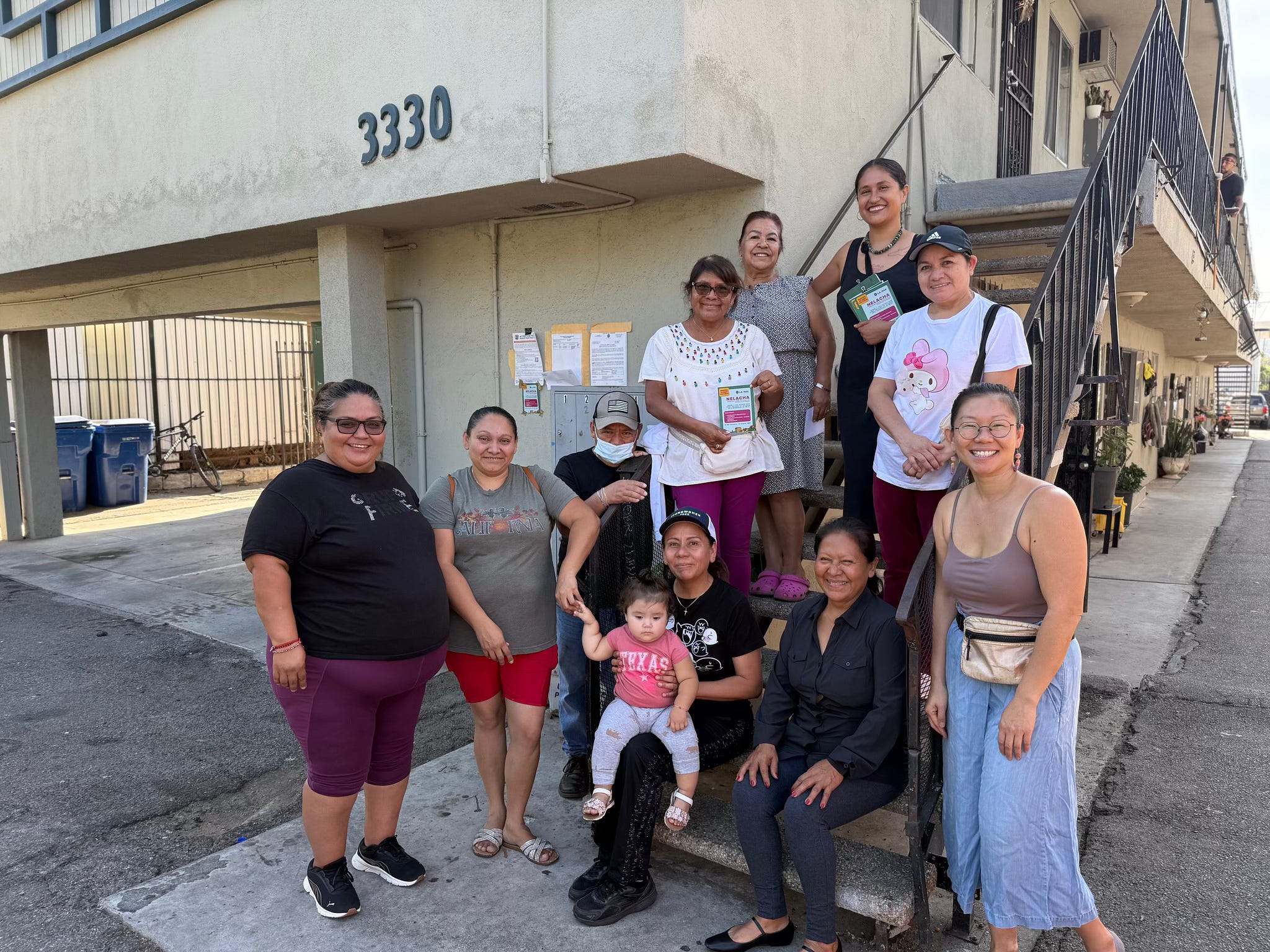
You’re paying market prices for buildings while trying to preserve affordable rents. How do you make those economics work?
Yes. We have to compete on the open market, which means paying market prices and moving on market timelines. We can’t wait for a deeply discounted property or spend years assembling a traditional affordable housing capital stack. A lot of the time, we open escrow and then figure out how to fund it. Every acquisition puts us on the clock.
Self-Help Ventures Fund has been a critical partner. On our early acquisitions, if we could raise roughly 20 to 25 percent of the project cost, Self-Help could bring the remaining 75 to 80 percent as a joint-venture partner. That allowed us to get into the market and start building a track record.
Then we layer in philanthropy, program-related investments, public funding, and increasingly community investment. The terms really matter because we’re deliberately preserving low rents. We need patient, low-cost capital that allows the properties to remain financially sustainable without pushing rents up.
And every deal builds the next one. People who said no to the first acquisition might say yes the second or third time because now we have a track record.
You’re working to raise a $25 million fund to acquire more buildings. Are there properties in your community you could preserve right now if you had that capital ready?
Yes. There are so many buildings we could preserve right now if we had capital ready to move. Owners and renters reach out to us all the time. Sometimes we have to say no because the building is outside Northeast LA and we are staying rooted where we are. Sometimes the building is right here in our neighborhoods, but the price is too high or the rehabilitation needs are too large.
Without very low-cost capital, we cannot make it work while keeping rents low.
Grant dollars are rare. What we need is what we call reparative capital, or community capital. Capital at 3% interest or less. Capital with long terms of at least a 10-year term, with the first few years as interest-only payments. That patience is what allows us to do repairs, keep rents steady, and care for the people who live there.
If we had the full $25 million raised for the fund, we could within half a year bring another 90 to 100 homes off the speculative market and into community stewardship.
You just closed on Drew Street, your largest purchase yet. Tell us more about that acquisition and the community that will benefit.
Drew Street is our largest two acquisitions yet: two neighboring, rent-stabilized apartment buildings in Glassell Park with 31 homes and more than 77 residents.
Drew Street also represents a big step forward for the model. It more than doubled our housing portfolio in a single acquisition, brought in our first public funding and our first community investors, and moved our partnership with Self-Help to 50/50 ownership.
What’s also remarkable is how the opportunity came to us. After we successfully acquired the Chapman Street building from a corporate landlord, that same owner approached us about Drew Street. They had seen that we could actually close at the market price.
Many Drew Street residents have lived there for decades. Some have lived there for over 40 years. They have built their lives there, their community, their circle of care, all rooted in Drew Street and in Glassell Park.
When we were first exploring the purchase, one resident who has lived there for more than 40 years asked us, “If LA Más buys this property, can I live here the rest of my life?”
That question captures what this work is really about. Community housing isn’t just about preserving buildings. It’s about giving people the stability to remain in the communities where they’ve built their lives. This acquisition offers lasting stability, affordability, and dignity. It means they can stay as long as they wish.
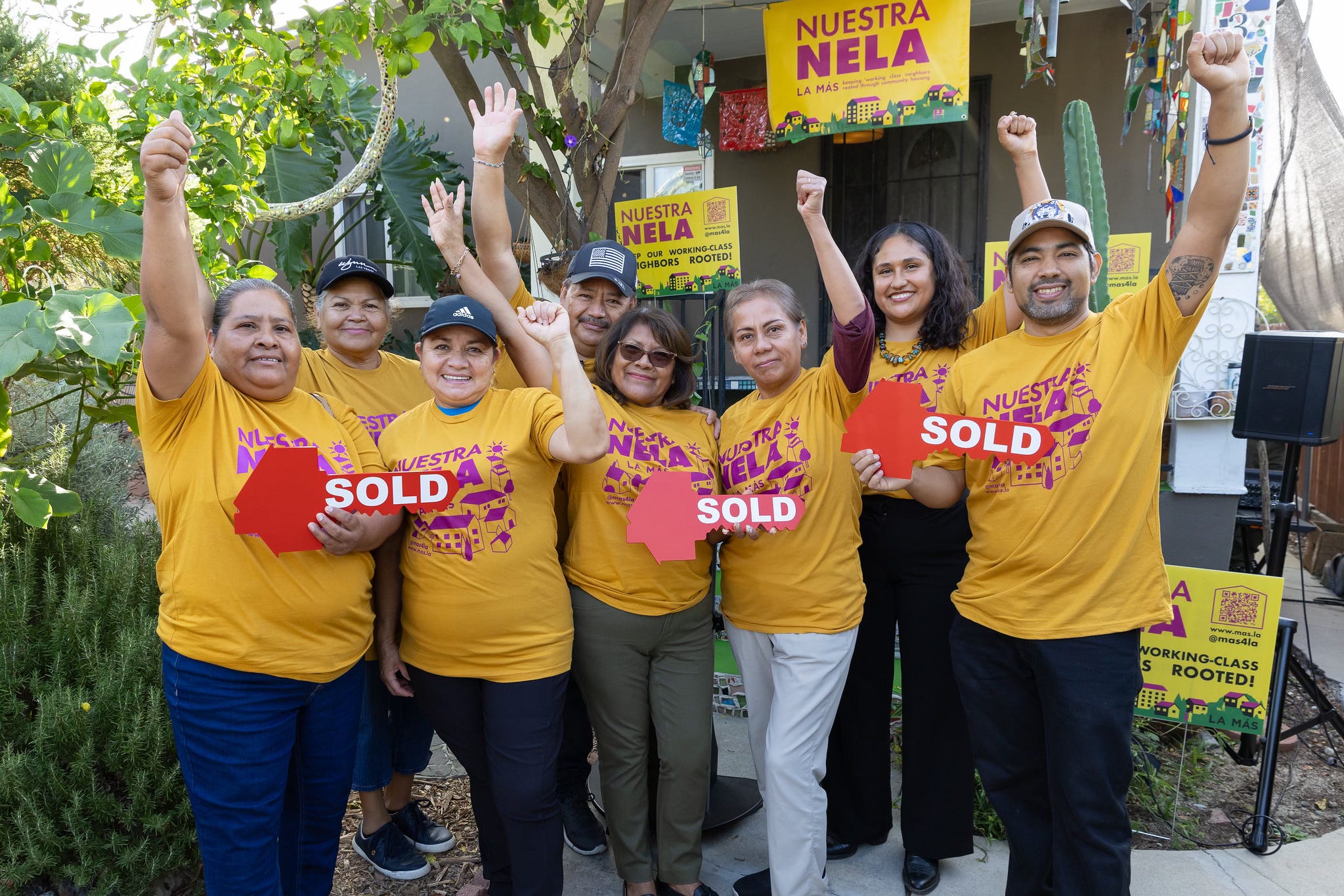
Drew Street brought together public funding, Self-Help, philanthropy, and individual investors. How are you, as a small locally rooted nonprofit, able to make this happen?
Drew Street is an $8.3 million project. The purchase itself was just over $6 million, with the rest going toward badly needed rehabilitation and maintenance.
To make this possible, we received $7 million from the Los Angeles County Affordable Housing Solutions Agency, including $5 million in a below-market loan, $1 million in subordinate debt, and a $1 million grant that required us to raise another $1 million in matching funds.
To fill that gap, we had a number of important partners: Self-Help Ventures Fund (SHVF) invested $500,000, LA4LA provided a $250,000 program-related investment, and eight individual community investors each invested $25,000—$200,000 in total—at 1 percent interest over five years. Donations helped cover the rest.
So catalytic capital—patient, low-cost, flexible funding—really does unlock much larger pools of money!
Yes. A $25,000 community investment can become part of an $8.3 million acquisition that permanently protects 31 homes. Now, we want to do much more. After raising $13 million to acquire 54 homes over the past two years, our goal is to raise $25 million to acquire another 90 or more homes over the next two years.
Reaching 90 or more homes in the next two years would be a huge benefit to the community, and would also create efficiencies for us as an organization, including the potential to bring more property management in-house.
That’s amazing. Imagine we come back a few years from now and LA-Más has realized this vision. What does Northeast LA look like—and what will it take to get there?
My hope is that in five or ten years, we will hold hundreds of homes off the market forever.
I hope our way of making homes affordable spreads, that many other organizations do this too, and that many everyday people say, oh, I can place my money there. I hope housing is no longer only privatized, at risk of speculation and distant from the people who live in these homes.
Because ultimately, success isn’t just about how many units we own. It’s about whether working-class residents who have made Northeast LA what it is can stay here, whether they have stability and dignity in their homes, and whether they have real power over what happens in their communities.
For readers who want to help—as donors, investors, or property owners—what would make the biggest difference right now?
If you are reading this, I hope you will join us in any way you can!
If you give to nonprofits, please consider giving to LA-Más. Become a monthly giver at $25 a month. That steady care makes all the difference, because rents do not pay for the ongoing resident engagement we are committed to, the listening, the gathering, the trust building that holds community.
The more of the capital we raise that can come in as grants and donations, the better, because it allows us to keep rents low. But we also need program-related investments and community investors who are willing to provide patient, low-cost capital.
If you are an investor, take a risk with us. Know it will pencil. We are not a typical project. We need debt that is a little more lenient, a little more patient. Please consider accepting lower returns, 3% or less, so homes can stay within reach.
And, if you own property in Northeast LA or elsewhere in the country, please consider not selling to the highest bidder or to a private landlord who may focus only on raising rents and displacing longtime residents. See if there is a community-rooted organization like LA Más you can call first, before you list on the market. If you are in Northeast LA, contact us!
One last question: Because you have had such an incredible career and are doing such impactful work, I would love to know who or what has helped you most along the way? And what advice would you give someone who wants to do this work like you, who is just starting out?
Oh, so many people have helped me along the way.
I want to honor the Center for Community Investment and its Fulcrum Fellowship, which I joined during COVID. It helped me ground in my role and in my lived experience as someone from Northeast LA, with the relationships and the organization to try to do things differently and to use capital in a way others said was not possible.
In LA, I was part of the Keep It Affordable Academy hosted by LA Local Initiatives Corporation and the Center by Lendristy’s BUILD Incubator, both spaces for developers of color and newer developers learning how to create affordable housing in a different way.
I have also loved being part of the Community Ownership Learning Action Lab, the COLA Lab based at the University of Miami, where I learn alongside four other organizations across the country in a community of practice for community-owned futures.
And I know our housing work would not be possible without partnership. I want to honor Self-Help Ventures Fund and especially their senior project manager Tim Quinn, who believed in what we could do and worked to make the existing capital system work for us, in true partnership.
For people who want to do this work, know this work is all about partnership. Be clear on why you do this work and what you bring, and on the network you are part of that can shift power and shift resources, so there can be more of us!